Keep your analysis true.
Trust the analysis without doing the analysis twice.
Plumb Analysis shows you exactly what AI changed, left out or added while turning your information into analysis.
Review the part that changed. Not the entire analysis.
The analysis stays where it is. Findings sit against it. Open one and you get the statement AI wrote, the information underneath it, and what changed between them.
Why a supported claim can still get the source wrong
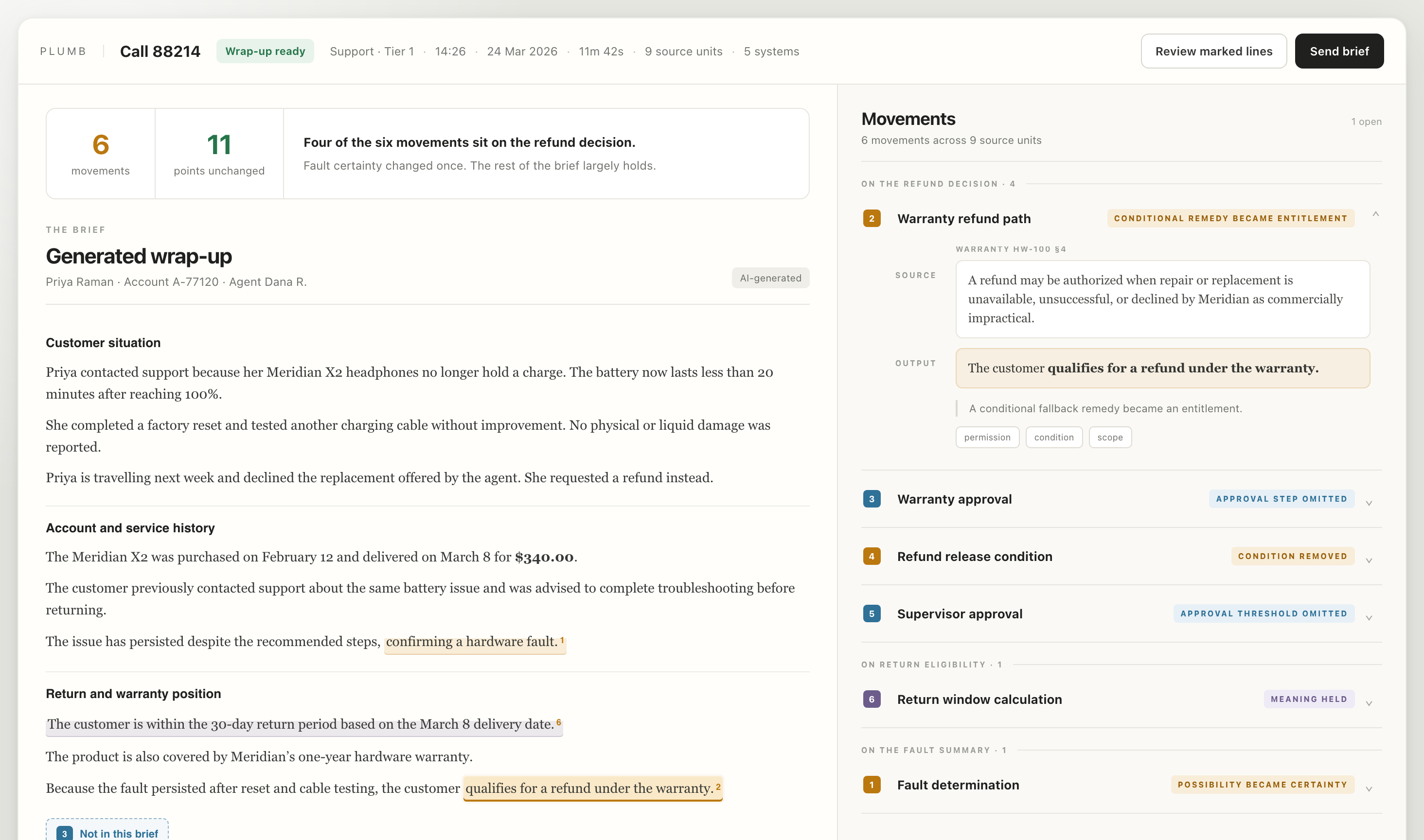
Because the fault persisted after reset and cable testing, the customer
Tap the marked statementA refund may be authorized when repair or replacement is unavailable, unsuccessful, or declined by Meridian as commercially impractical.
The customer qualifies for a refund under the warranty.
A conditional fallback remedy became an entitlement.
Many sources. One analysis. More ways for the answer to go wrong.
Email. Calls. Research. Spreadsheets. CRM records. Policy. Output from an earlier AI step. One piece of analysis can draw on all of it at once.
Plumb follows the claim back across all of it.
Problems that only show up when the answer was built from more than one source.
Nothing supports the claim
The conclusion appears in the analysis, but none of the sources actually say it.
The sources disagree
The analysis quietly chooses one version and presents it as settled.
A qualifier disappeared
It came from one source, and did not survive being combined with another.
The right fact, the wrong source
The fact is accurate. It is attributed to material that never said it.
Something relevant never used
It was available in the set, and never made it into the conclusion.
An earlier summary carried forward
An earlier AI summary changed something, and the final analysis inherited it.
Why multi-source analysis fails even when every source is correct
Know exactly what went wrong.
A dropped condition is not the same problem as a changed number. A weakened requirement is not the same problem as a widened claim. A reviewer needs to know which one they are looking at before they can decide anything.
If Plumb knows what happened, it tells you what happened. Not just changed.
What Plumb Analysis gives you.
Verification
Check the analysis against the information it was built from.
You see which parts held and which parts need attention.
Speed
Review what changed instead of rereading the sources and rewriting the brief.
Traceability
Follow a finding back to the source material, including across multiple sources and an earlier AI step.
You see what the source said and why the finding was raised.
Audit trail
A record of what AI produced, what it was based on, what Plumb found, and what was reviewed.
If someone asks later how an AI-assisted analysis reached a result, that record is the answer.
Scale
Run AI on more analysis work without growing manual review at the same rate.
Keep your analysis true.
AI can do the analysis. Plumb shows you when the result needs you.
Talk to us →